
CartFlow
A microservice-based eCommerce backend designed to deeply understand distributed systems, scalability, and real-world backend tradeoffs.
Timeline
1 month
Role
Backend Developer
Team
Solo
Status
CompletedTechnology Stack
Key Challenges
- Designing microservice boundaries
- Service-to-service communication
- Data consistency across services
- Caching strategy with Redis
- Avoiding tight coupling
Key Learnings
- Microservice architecture fundamentals
- Tradeoffs between monoliths and microservices
- Caching and performance optimization
- Event-driven communication
- Scalability vs complexity
- Backend system design
CartFlow: Microservice eCommerce Backend
Overview
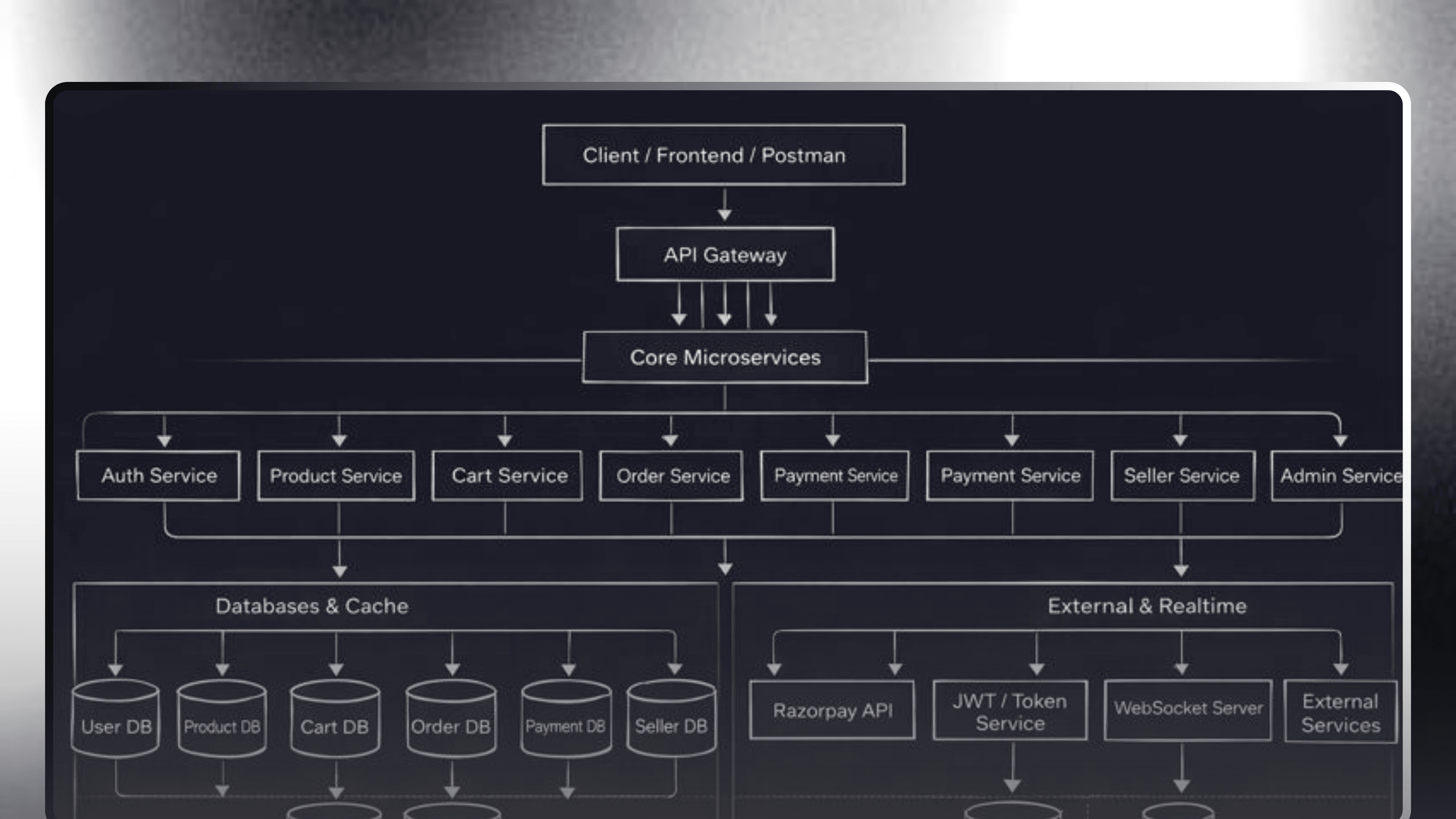
CartFlow is a backend-focused project built to deeply understand how microservice-based systems work in real-world scenarios. Instead of building a full frontend product, the focus was on designing and implementing independent backend services that could scale, communicate, and evolve separately.
The system was designed around a typical eCommerce domain, with separate services responsible for carts, orders, and products, mimicking how large-scale platforms structure their backend systems.
What the System Handles
- Product Service: Manages product data, availability, and pricing.
- Cart Service: Handles cart creation, item management, and cart state.
- Order Service: Processes order creation and lifecycle management.
- Caching Layer: Uses Redis to reduce database load and improve response times.
- Inter-Service Communication: Services communicate using APIs.
- API Security: Structured and secure REST APIs designed for service consumption.
- AI Agent: Utilizes Langchain for product fetching & suggestion & adding product into cart.
Why I Built This
I built CartFlow to go beyond CRUD-based backend projects and understand:
- How large systems split responsibilities across services.
- How services communicate without becoming tightly coupled.
- The real complexity introduced by microservices.
- How caching and messaging affect performance and reliability.
This project was intentionally backend-only, with the goal of learning system design through implementation, not building a market-ready product.
Tech Stack
- Node.js
- Express.js
- MongoDB
- Redis
- Langchain
- React
- Tailwind CSS
Why It Was Not Deployed
CartFlow was never meant to be deployed as a production product, and that decision was intentional.
- The microservice setup felt over-engineered without a real business use case.
- Managing multiple services locally highlighted the operational complexity of microservices.
- Without real users or traffic patterns, further scaling would have been artificial.
- A monolithic approach would have been more practical for an actual MVP.
Rather than forcing deployment, I chose to treat CartFlow as a learning-focused system design project, extracting the architectural insights instead of polishing unused infrastructure.
This decision helped me better understand when microservices make sense — and when they don’t.
Key Takeaways
- Microservices introduce real operational overhead.
- Clear service boundaries are critical for maintainability.
- Caching and async communication significantly improve performance.
- Not every problem needs a distributed architecture.
- Architectural decisions should be driven by real use cases, not trends.
After Build & Impact
- Gained hands-on experience with microservice architecture.
- Developed a strong intuition for backend scalability tradeoffs.
- Applied learnings to later projects with more practical architectures.
- Improved confidence in backend system design discussions.
- Built a solid foundation for working on platform-level backend systems.
Future Possibilities
- Convert the system into a modular monolith.
- Add real-world use cases and traffic simulation.
- Introduce service discovery and monitoring.
- Explore containerization and orchestration (Docker, Kubernetes).
- Apply the architecture selectively to suitable projects.